

Choosing a Top Film: What Happens at the Sealing Edge Matters
A little product on the rim of a tray can turn a straightforward packaging operation into a demanding sealing task.
The film still has to close the pack reliably. The line has to maintain its output. Later, the consumer expects to lift the tab and remove the lid without a struggle.
When choosing a top film, these practical details matter. Barrier values and film thickness matter, but they only tell part of the story. The film also has to work with the tray, the product and the conditions on the packaging line.
Start with the seal—and the conditions around it
Consider a tray containing a prepared meal with sauce. During filling, some product may reach the sealing area.
That possibility should be part of the development brief. How sensitive is the proposed material combination to contamination? Which filling and handling measures help keep the rim clean? What happens when temperature, pressure or sealing time varies?
A claim such as “good sealability” does not answer these questions on its own.
Trials should use the intended tray or bottom film and conditions representative of production. Where contamination is a foreseeable issue, its influence needs to be evaluated specifically. A film’s ability to tolerate it must be demonstrated for the application.
Production speed changes the discussion
A film that seals successfully during an initial trial still needs to perform at the intended line speed.
As output increases, the time available for sealing may become more demanding. Temperature, contact time and pressure have to be considered together with the sealing surface and film structure.
Changing one setting can affect the result elsewhere. Raising the temperature, for example, should not be treated as a universal answer to an inconsistent seal.
The useful question is: over which operating conditions does this particular combination produce a reliable result?
For a packaging team, understanding that processing window is more valuable than knowing that a film sealed successfully at one setting.
Barrier performance cannot compensate for a leaking pack
For products packed under a modified atmosphere, the barrier and the seal have different jobs.
The film structure limits gas transmission through the material. The seal closes the package. Both need to perform as intended.
When evaluating a chilled-food application, the discussion should therefore include the required shelf life, storage conditions, packaging atmosphere and integrity of the finished pack.
An oxygen-barrier value alone cannot establish the shelf life of the packaged product. That requires assessment of the actual product and packaging system.
Antifog answers a different question
A consumer looking at a chilled tray wants to see the food.
Condensation on the inside of the lid can obscure that view, even when the film itself is highly transparent. Antifog is therefore a separate consideration from barrier performance.
For development, the practical question is how the pack looks under its intended conditions: after cooling, during storage and on display.
This also makes the distinction clearer for customers. Barrier selection addresses protection requirements; antifog addresses visibility when condensation would otherwise interfere.
Opening deserves its own trial
The packaging process ends with a sealed pack. The consumer’s experience begins when they try to open it.
A useful opening trial asks more than whether the lid can be removed:
- Is the tab easy to find and grip?
- Does peeling start without excessive effort?
- Does the film come away consistently?
- Does it tear or leave unwanted fragments?
- How does opening behaviour change after storage?
The desired result depends on the film, the sealing surface and the process. Evaluating these together helps avoid a situation in which a pack performs well on the line but is frustrating to use at home.
A thinner film needs a complete assessment
Reducing film thickness is an obvious place to look for material savings. The development work lies in maintaining the functions the application needs.
A thinner structure still has to withstand handling, run reliably, seal consistently and provide the required protection.
The same principle applies when changing the material composition to support recycling objectives. The proposed top film must be considered alongside the tray or bottom film and the other packaging components.
Neither a lower thickness nor a material name proves that the finished package is suitable. The change has to be assessed and tested.
Where ERGO.Flex fits
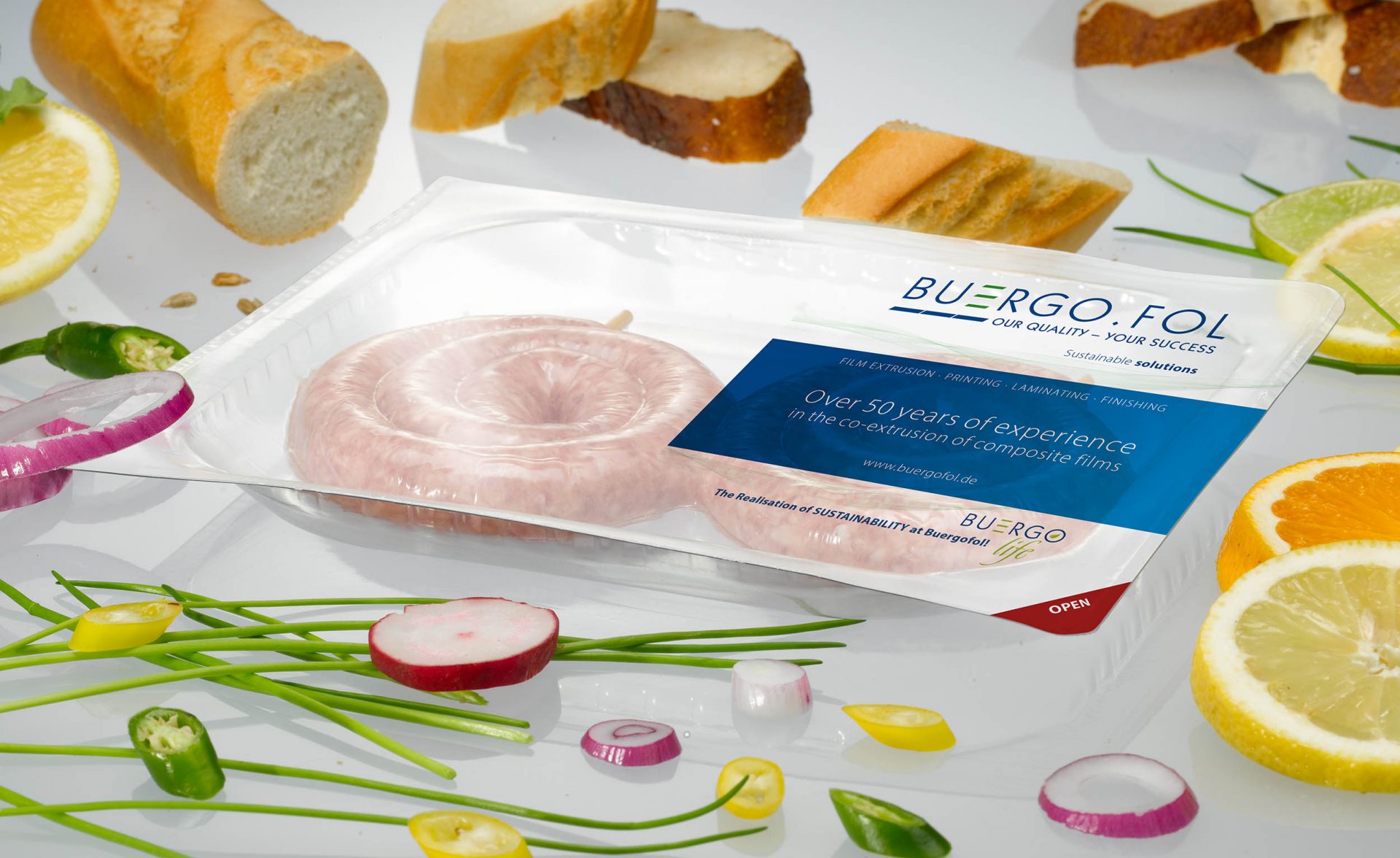
BUERGOFOL’s ERGO.Flex top films are designed for thermoforming and traysealer applications producing MAP or vacuum packs. The range includes high- or medium-barrier options, optional antifog, printing possibilities and consumer-friendly peel. Polyolefin variants are also available for recycling-oriented packaging concepts. Buergofol
hoosing a top film starts with a concrete brief: what is being packed, which sealing surface is used, how the line operates and what the finished package needs to withstand.
A useful enquiry therefore includes the product, tray or bottom-film specification, intended shelf life, storage conditions, machine details and required opening behaviour.
Those details give the development discussion a practical starting point—and make the next trial more informative.
Planning a new tray-packaging application or reviewing an existing structure? Discuss your product, machine and packaging requirements with BUERGOFOL.
Comments are closed.